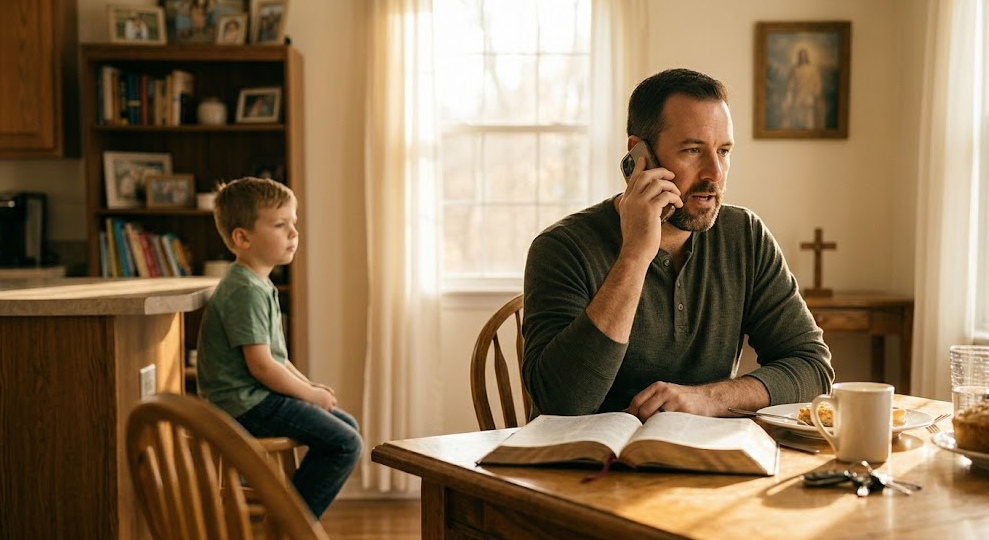
If you’ve ever lain awake wondering whether you’re actually getting through to your kids – you’re not alone. Every Christian parent hit this point. You can teach a child a hundred Bible verses, but moral character isn’t built through memorization. It’s built through small, repeated moments that shape who they become.
The good news is the Bible isn’t vague about this. Scripture gives us real, practical principles for raising children with strong moral character – not just spiritual knowledge, but the kind of integrity that holds up under pressure. Here are five that actually work.
1. Model It Before You Teach It
Children don’t become honest because you told them to be honest. They become honest because they watched you choose truth when a lie would’ve been easier.
Deuteronomy 6:6-7 says the commandments should first be “on your hearts” – and only then taught diligently to children. The order matters. You can’t hand your kids something you don’t actually carry yourself.
Practical step: Before correcting a character flaw in your child, ask yourself honestly – where have they seen this exact behavior modeled at home? Sometimes the most powerful parenting move is fixing something in yourself first.
2. Let Consequences Do the Teaching
One of the hardest things for loving parents to do is step back and let a child experience the natural result of their choices. But Galatians 6:7 reminds us, “A man reaps what he sows “ That principle doesn’t pause for childhood.
Rescuing kids from every uncomfortable outcome – forgotten homework, a broken promise to a friend, a late bedtime that wrecks the next morning – actually robs them of the lessons that build responsibility.
Practical step: Next time you’re tempted to fix a problem your child created, pause. Ask whether this is a moment to protect them, or a moment to let the lesson land.
3. Correct Privately, Praise Publicly
How you correct a child shape whether they internalize humility or develop shame. Scripture consistently models private, restorative correction – not public embarrassment.
Proverbs 15:1 says, “A gentle answer turns away wrath, but a harsh word stirs up anger.” The goal of discipline was never to humiliate – it’s to restore. A child corrected with dignity grows into an adult who can receive feedback without becoming defensive.
Practical step: Save tough conversations for one-on-one moments. Save praise for the family dinner table.
4. Teach Responsibility Before Rights
Our culture constantly tells children what they’re owed. Scripture flips that script entirely. Philippians 2:3-4 calls believers to “value others above yourselves” – a posture that runs completely against the grain of entitlement.
Children raised to ask “What’s my responsibility here?” before “What’s fair to me?” grow into adults who lead well, serve well, and handle conflict with maturity instead of defensiveness.
Practical step: Build small daily responsibilities into your child’s routine – not as punishment, but as identity formation. Capable kids become confident kids.
5. Anchor Everything in a Real Relationship with God
This is the principle that holds the other four together. Moral character without a living faith eventually runs out of fuel. Kids can follow rules for a season, but lasting character is sustained by a genuine relationship with Christ – not just religious habit.
Proverbs 22:6 promises that training a child “in the way he should go” shapes who they become for life. That training isn’t a one-time lecture. It’s a daily, lived-out faith that your child watches and eventually makes their own.
Practical step: Make faith conversations normal, not formal. Talk about God in the car, at dinner, during hard days – not just on Sundays.
You Don’t Have to Figure This Out Alone
Raising kids with real moral character is one of the hardest, most important assignments God gives a parent – and most of us were never handed a clear roadmap for how to do it.
This is exactly the gap Elder Mark Hoke set out to close. His book, Building Men and Women of Character, takes these Biblical principles even deeper – walking parents and young people through what character formation actually looks like day to day, not just in theory. If you want a fuller framework for how to build strong moral character in children, it’s a resource worth having on your shelf.
You can also read our full guide, What Does It Really Mean to Build Character? A Biblical Guide for Men, Women, and Families, for a deeper look at what scripture says about character formation across every stage of life.
Parenting with character in mind isn’t about perfection. It’s about showing up, day after day, pointing your children toward something – and someone – bigger than themselves.